
OfficeOS blog
AI is changing the service industry
AI-native service companies sell finished work instead of software seats. For app owners, that means buying the update rather than managing the developer process.
Software companies used to sell tools. Service companies sold the work.
That split made sense when software helped a human move faster. A CRM helped a salesperson track leads. Accounting software helped a bookkeeper close the month. A project management tool helped a team coordinate tasks.
AI changes the shape of that deal. In more categories, the customer does not need a better tool. The customer wants the finished output.
Y Combinator described this in its 2026 Requests for Startups as AI-native service companies: companies that sell the service itself instead of selling software that helps someone perform the service. Sarah Tavel made the same point in Sell work, not software: LLMs let startups sell the work product, priced against the cost of a human doing the job, rather than a per-seat productivity tool.
That idea explains why services are about to change more than software dashboards.
The old service business scaled with headcount
Traditional service companies grow by adding people.
An agency wins more clients, then hires more account managers, designers, developers, analysts, or operations staff. A consulting firm sells more projects, then staffs more teams. A business process outsourcing company wins more volume, then adds more workers.
That model can produce strong companies, but the math stays tied to people. More work requires more headcount. More headcount creates more management, training, review, and coordination. Margins stay under pressure because each extra customer brings extra human labor.
AI changes the cost structure. One experienced operator can now use models, agents, scripts, and internal tools to complete work that used to need a team. The company still needs people, but the people supervise systems that perform more of the repeatable work.
The result is a new kind of service company: fewer people, more output, tighter process, better margins.
Customers buy outcomes when the work is painful
Service buyers do not wake up hoping to adopt another platform.
They want the tax filing done. They want the insurance claim handled. They want compliance paperwork prepared. They want the mobile app update shipped.
Software works when the customer has a trained employee ready to use it. Services work when the customer wants to hand off the job.
AI-native service companies win when the buyer already outsources the task, delays it, or hates managing it. The buyer has shown a willingness to pay for completion. AI lets a startup deliver that completion with a smaller team and a more consistent process.
This is why the service industry is such a large target. Companies spend far more on services than on software. A founder who replaces a service can price against the cost of the work, not against the cost of another SaaS seat.
The product becomes the process
An AI-native service company still needs software. It may use agents, internal dashboards, code generation, document extraction, QA checklists, and customer portals.
The customer does not need to use most of it.
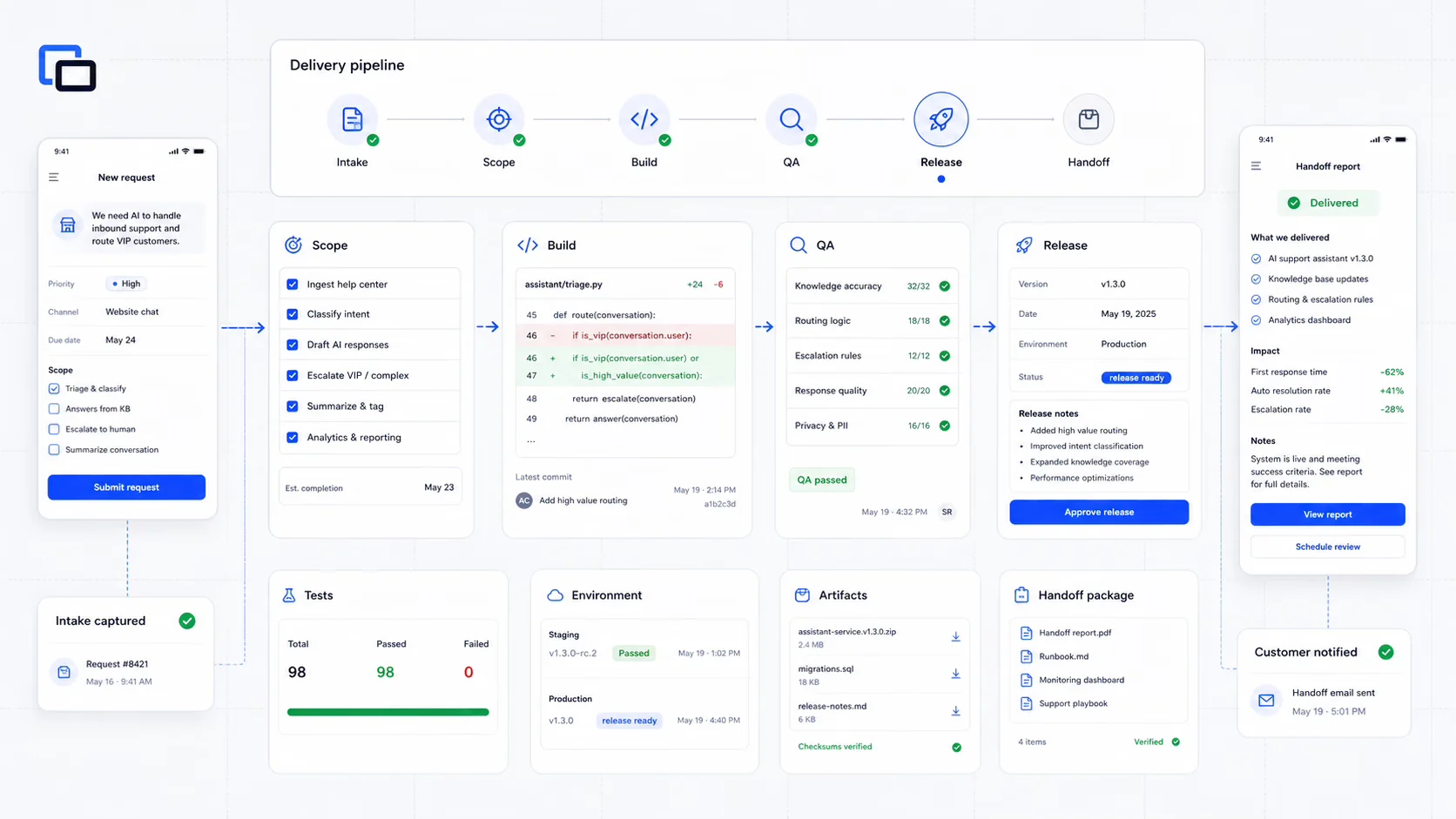
That is the shift. The software sits inside the service company. It helps the team scope, execute, review, and deliver the work. The customer sees the request, the output, and the report.
This creates a different product discipline from SaaS. The company has to define the unit of work. It has to know what a good output looks like. It has to encode quality checks. It has to decide which parts AI can handle, which parts need human review, and where the release or handoff can fail.
The defensibility comes from that operating system: the prompts, workflows, review standards, customer data, edge cases, and delivery muscle built around one category of work.
AI does not remove accountability
Customers will not accept "the model made a mistake" as an excuse.
If a tax filing goes out wrong, the customer blames the provider. If a compliance document misses a requirement, the provider owns the problem. If an app update breaks subscriptions, the owner has to answer to users.
That means AI-native service companies need stronger quality systems than traditional agencies. They cannot rely on vibes, loose freelancer handoffs, or a final skim before delivery.
Good operators will build acceptance criteria before execution. They will use AI to draft and assemble work, then run checks tied to the customer outcome. They will give customers a clear record of what changed, what passed, and what needs attention.
The winners will combine speed with responsibility. The weak version of this market sells cheap AI output. The strong version sells completed work with clear ownership.
Mobile app updates fit this pattern
OfficeOS exists because app owners do not want another tool for managing developers. They want the update shipped.
A non-technical founder can often describe the next mobile update in one sentence:
- Fix the onboarding copy users keep misunderstanding.
- Test a new paywall message before the next campaign.
- Add one field to signup.
- Patch the layout bug on small phones.
The owner knows the work. The hard part starts after the request. Someone has to scope the change, touch the codebase, check the affected flows, prepare the release notes, and decide whether the build is ready.
That is service work. AI can help produce the code, but the customer still needs ownership of the full path from request to release.
OfficeOS sells that finished update. You send the request. We turn it into acceptance criteria, implement the change, run QA, and hand back a release-ready package. The internal software matters because it helps us deliver the work. The customer buys the completed update.
The service industry will split
Some agencies will use AI to cut costs while keeping the same delivery model. They will move faster, but customers will still manage briefs, feedback, QA, and handoffs.
The stronger companies will redesign the service around a narrower promise. They will say: send us this kind of work, and we will return this finished output with these checks.
That is a better bargain for customers. They do not need to learn a new tool, hire another contractor, or become the release manager for work they wanted to delegate.
AI is changing services because it changes who does the work. The customer still pays for trust, judgment, and completion. The best companies will use AI inside the operation, then sell the outcome in plain language.
For mobile app owners, that means a small update should no longer require a new developer chase. The update request should come back as a tested release.